
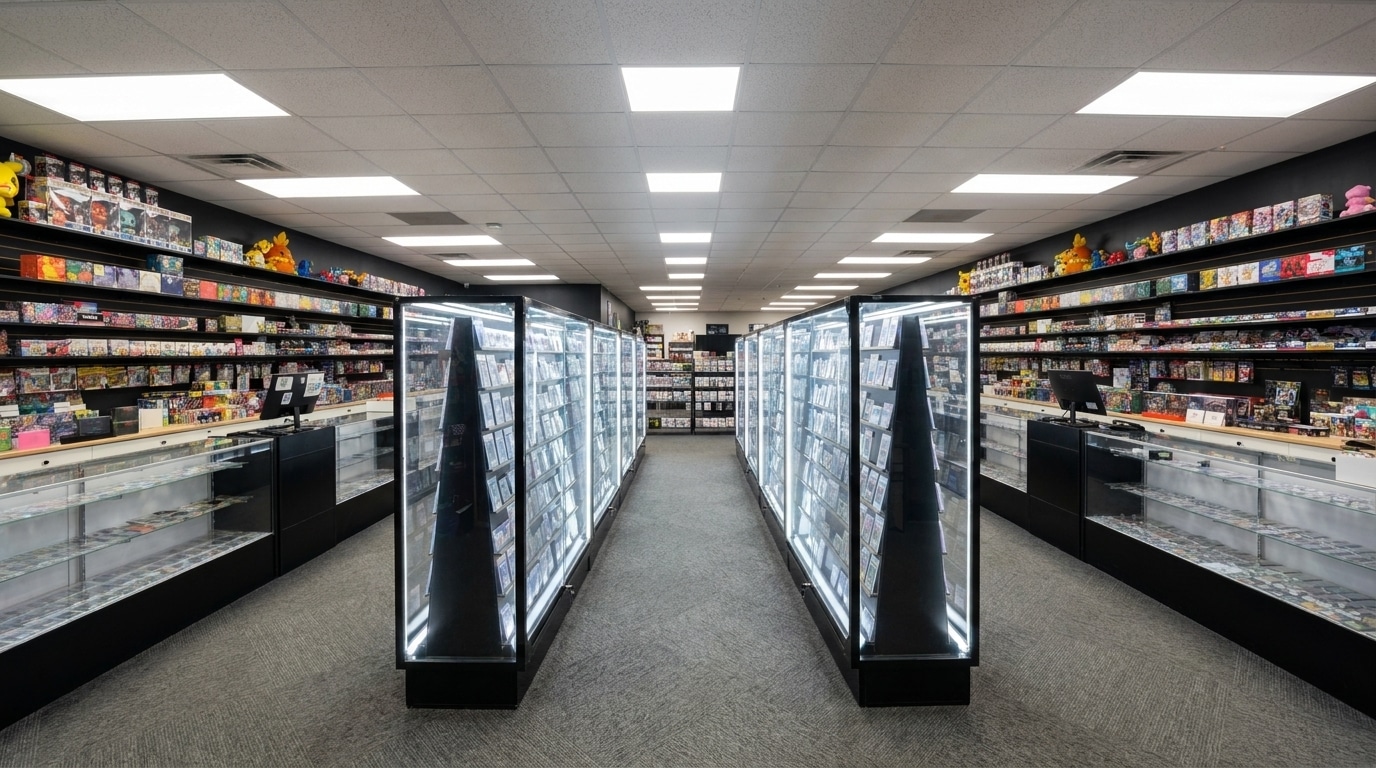
How Much Does It Cost To Open a TCG Shop?
Trading card games just had the biggest year in their history. ICv2 reported that the North American hobby games market grew 40% to $3.66 billion in 2025, and trading card games now account for roughly two-thirds of those dollars. Hasbro's Magic: The Gathering grew 59% to $1.72 billion, and The Pokémon Company posted record sales on the back of roughly 10 billion cards produced in a single fiscal year. Even GameStop has rebuilt its stores around collectibles and added event tables.
That demand has more people asking what it actually takes to open a dedicated TCG shop. A TCG store runs on different economics than a sports card shop. Sealed product, singles, weekly tournaments and organized play programs from Wizards of the Coast, Pokémon, Bandai and Ravensburger each shape how much space you need, how much inventory you carry and how you earn repeat visits.
This guide breaks down every major cost of opening a TCG shop in 2026, from licenses and play space to opening stock, display cases and the software that manages thousands of singles. Every range comes from current industry sources, so you can plan a store that is ready for both collectors and players.
What Kind of TCG Shop Are You Building?
The biggest decision is how much floor space you give to play. A counter-and-cases shop focused on sealed product and singles can operate in a small footprint, but most TCG stores grow through events, and organized play programs from Wizards of the Coast and Bandai require dedicated seating for at least eight players. More seats mean more rent, tables and chairs, but they also mean prereleases, weekly leagues and a reason for players to come back every week.
| Store Concept | Estimated Startup Range |
|---|---|
| Lean sealed & singles shop (800–1,500 sq ft) | $30K – $65K |
| Tournament-ready store with dedicated play space | $75K – $125K |
| Large multi-game store with event hall | $125K – $200K+ |
Lean shops get open fastest and test the local market with less risk, but they leave event revenue on the table. Tournament-ready stores carry more fixed cost, yet organized play is what earns allocation, promos and loyal customers. Large multi-game stores spread risk across Pokémon, Magic, One Piece, Lorcana and newer games, and need the most capital to do it.
Independent advantage: Many successful owners open with a modest play area sized for eight to twenty players, then expand seating once weekly events consistently fill. Planning the layout so play space can grow saves a costly rebuild later.
Licenses, Permits & Play Programs
Start with an LLC, which costs $35 to $500 to file depending on the state, a seller's permit, which is free in many states and up to about $100 in others, and a local business license. Because a play area turns part of your store into an assembly space, your certificate of occupancy matters more than it does for a typical retailer. Under the International Building Code, seated table-and-chair areas are calculated at 15 net square feet per person, and once a space reaches 50 occupants, requirements such as panic hardware on exit doors can apply. Certificate fees vary by city, from under $100 to around $500.
If you buy collections from the public, check your state and city's secondhand dealer rules. Florida requires registration with the Department of Revenue at $6 per location plus fingerprinting, and some cities impose holding periods on purchased goods. The good news is that the major organized play programs do not charge to join. Wizards Play Network requires an open storefront, seating for eight or more and a walkthrough video, Play! Pokémon store status is free once organizers pass the Professor exam and a background check, and Bandai's One Piece program requires a play space for eight and an account with an official distributor.
| License / Permit | Cost Range |
|---|---|
| LLC formation (state filing fee) | $35 – $500 |
| Sales tax / seller's permit | $0 – $100 |
| Local business license | $50 – $400 |
| Certificate of occupancy (incl. change of use) | $95 – $500 |
| Secondhand dealer license (where required) | $6 – $300 |
| WPN, Play! Pokémon, One Piece & Lorcana programs | $0 |
| Typical Total | $180 – $1,800 |
Open first, apply second: Wizards of the Coast will not approve a store that is still under construction. Plan for your fixtures, play tables and sealed Magic inventory to be in place before you record the WPN walkthrough video.
Location & Rent
TCG shops are destination stores. Players will drive to a store with a good event calendar, so evening parking, a safe area after dark and enough square footage for tables matter more than mall foot traffic. Most small shops plan for 800 to 1,500 square feet. At 15 square feet per seated player, a 32-seat play area needs about 480 square feet of table space before aisles, which is why play space often takes a quarter or more of the floor.
CBRE put average U.S. retail asking rent at $24.79 per square foot per year in the second quarter of 2026. Rents vary widely by city: TenantBase lists ranges of $15 to $24 in Phoenix and $16 to $28 in Tampa, while Miami runs above $46. Here is what that means for a 1,500-square-foot shop.
| Market Type | Est. Monthly Base Rent (1,500 sq ft) |
|---|---|
| Lower-cost market (~$16/sq ft/yr) | ~$2,000 |
| National average (~$24.79/sq ft/yr) | ~$3,100 |
| High-cost market (~$46.59+/sq ft/yr) | ~$5,800+ |
Triple-net charges typically add $2 to $4 per square foot per year. If the space needs real construction, national fit-out averages land near $149 per square foot, while basic retail improvements can run $40 to $90 per square foot. A former retail space with open floor area, good lighting and restrooms is the most affordable path to a play-ready store.
Location insight: Ask the landlord about evening and weekend hours, neighboring tenants and parking before you sign. A Friday Night Magic crowd of thirty players needs parking spaces that a daytime-only neighbor might fight you for.
Opening Inventory
Opening stock estimates for a small TCG shop range from about $10,000 to $32,000, while larger stores may invest $100,000 or more. The bigger challenge is not money but access. Distributors allocate hot Pokémon releases based on account history, and new stores commonly receive limited allocation for their first six to twelve months. That makes singles and buying collections especially important early on.
Sealed Product
Booster boxes, Elite Trainer Boxes, starter decks and collector products bring in new customers and fuel events. Sealed margins are thinner than singles, and allocation limits how much of the newest product you can get.
Singles
Individual cards are where TCG shops build margin. Stores commonly buy cards from customers at roughly 40% to 70% of market value in store credit and 25% to 50% in cash, then resell at market. A deep, well-organized singles inventory gives competitive players a reason to shop with you every week.
Supplies
Sleeves, binders, toploaders, deck boxes and playmats sell with nearly every visit. Watch supply costs: accessory maker BCW added a 34% tariff surcharge on China-made products at wholesale in 2025.
| Inventory Category | Share of Opening Budget |
|---|---|
| Sealed product | 30% – 60% |
| Singles (modern & vintage) | 35% – 60% |
| Supplies & accessories | 5% – 10% |
| Typical Opening Inventory | $20K – $32K |
Inventory discipline: Spread sealed purchases across several games so one allocation shortage does not empty your shelves, and reinvest early singles profits into buying collections, which build inventory at a lower cost than wholesale.
Fixtures & Store Design
TCG fixtures have to protect high-value singles while keeping sealed product visible and easy to browse. Countertop cases near the register hold premium singles under lock, and taller cases with tiered shelving display booster boxes and Elite Trainer Boxes. A 48" countertop TCG display case starts under $300, and the 72" TCG wax display case is one of the most popular choices for sealed product.
Double-sided aisle cases separate your retail floor from your play area while showing product to both sides, and slatwall handles sleeves, deck boxes and binders on hooks and shelves. A free layout plan shows how cases, aisles and play tables fit together in your exact footprint.
| Fixture | Estimated Cost |
|---|---|
| 2 countertop TCG cases for singles | $600 – $1,000 |
| 1–2 TCG wax cases for sealed product | $900 – $1,800 |
| 1 double-sided aisle TCG case | $1,350 – $1,765 |
| 4–8 slatwall panels + hooks for supplies | $400 – $850 |
| Glass-front checkout counter | ~$400 |
| Estimated Fixture Package | $3,650 – $5,800 |
Play tables and chairs are a separate line, typically $2,000 to $6,000 depending on seat count.
DISPLAYARAMA builds display cases specifically for trading card games, from countertop singles cases to double-sided aisle editions and full wall systems. Send us your floor dimensions and we will show you how retail, cases and play space fit together.
Prefer to talk through your space? Call us at 1-800-292-5227.
Get My Free Store Fixture Layout Plan →Technology, Staffing & Operations
A TCG shop's point-of-sale system has to track thousands of individual cards with prices that change daily. BinderPOS runs $100 to $150 per month on top of Shopify and syncs with TCGplayer, though new sign-ups are currently waitlisted. Shopify POS Pro runs about $89 per location per month, and Crystal Commerce starts around $99 per month plus a percentage of integrated sales. If you sell singles on TCGplayer, budget for a 10.75% commission plus 2.5% and $0.30 in payment processing per order.
Hardware such as computers, scanners, label printers and card readers typically costs $3,000 to $5,000. A basic security system runs $500 to $1,500, and a safe for high-value singles adds $300 to $800. Retail general liability insurance averages about $42 per month, or $95 per month for a business owner's policy. Retail salespeople earn a median of $17.03 per hour according to the Bureau of Labor Statistics, and the best TCG staff can also judge events and grade card condition.
| Technology / Operations | Estimated Cost |
|---|---|
| POS hardware, scanners & label printers | $3,000 – $5,000 |
| POS & singles inventory software | $89 – $250 / month |
| Security system | $500 – $1,500 |
| Safe for high-value cards | $300 – $800 |
| Insurance (first year) | $500 – $1,150 |
| Play tables & chairs | $2,000 – $6,000 |
| Launch marketing | $1,000 – $5,000 |
| Upfront Total (excl. monthly software) | $7,300 – $19,450 |
Total Cost To Open a TCG Shop
Putting it all together, a small TCG shop with a modest play area typically needs about $48,000 to $92,000 to open, including a cash cushion. Larger stores with event halls and deeper inventory can run $125,000 to $200,000 or more. Shop owners who have been through it consistently warn that startup costs run higher than planned, so the cushion line is not optional.
| Cost Category | Estimated Range |
|---|---|
| Licenses, permits & formation | $180 – $1,800 |
| Lease deposit & light fit-out | $10,000 – $20,000 |
| Opening inventory | $20,000 – $32,000 |
| Display cases & fixtures | $3,650 – $5,800 |
| Technology, play space, insurance & marketing | $7,300 – $19,450 |
| Cash cushion | $7,000 – $13,000 |
| Total | ~$48K – $92K |
Timeline to profitability: Card shop software provider TCGSync reports that shops that reach break-even usually do so between months 9 and 18. Retail overall has better-than-average staying power, with 58.3% of new retail establishments still open after five years according to the Bureau of Labor Statistics. Keep at least three months of expenses in reserve while allocation and events ramp up.
How TCG Shops Grow Revenue
The shops that last do not rely on the next hot booster set. They build several revenue streams around the community that walks through the door every week.
Build a Buylist
Buying cards from players at 40% to 70% of market value in store credit and reselling at market is where TCG shops earn their best margins. Store credit keeps that value inside your store.
Run Organized Play
Weekly leagues and prereleases bring players back every week. 2025 Magic prerelease entries ran $40 to $52 per player, and participation in official programs supports your product allocation.
Sell Singles Online
Listing inventory on TCGplayer, eBay or your own webstore turns slow-moving singles into cash. Model total marketplace fees at roughly 13% to 16% when you set prices.
Offer Grading Submissions
GemRate data shows about 26.8 million cards were graded in 2025, and TCG grading nearly doubled. Bulk submission services earn fees and bring in high-value collectors.
Carry More Than One Game
One Piece, Lorcana and newer releases such as Riftbound reduce your dependence on Pokémon allocation and attract different player groups to different nights of the week.
Monetize the Play Space
Table fees, party rentals and paid memberships turn seating into steady income. Game cafés commonly charge around $5 per person for play space, and private parties earn more.
Why Your Fixtures Matter
In a TCG shop, display cases are your security system, your showroom and your sales staff. Collectors judge a store by how its premium singles are presented, and a bright, organized case tells them their cards will be handled with care when they come back to sell. Players, meanwhile, need to see sealed product and supplies at a glance on their way to the tables.
Layout also controls flow during events. A well-planned shop keeps the play area clear of the register line, puts supplies on the path between the two, and uses case placement to keep high-value inventory in staff sightlines even when the room is full.
- Locking countertop cases for premium singles at the register
- Tiered TCG cases sized for booster boxes and Elite Trainer Boxes
- Double-sided aisle cases that divide retail and play areas
- Slatwall with hooks and shelves for sleeves, deck boxes and binders
- A glass-front checkout counter for impulse packs and accessories
DISPLAYARAMA carries more than 40 TCG display cases, from entry-level countertop cases to multi-level and wall editions with LED lighting, plus the slatwall and counters to finish the store. Bulk pricing is available for full openings.
See the full lineup built for TCG shops, or call 1-800-292-5227 to talk with our team.
Shop TCG Shop Fixtures →Opening a TCG Shop: Common Questions
How much does it cost to open a TCG shop?
A small TCG shop with a modest play area typically costs about $48,000 to $92,000 to open, including inventory, display cases, technology and a cash cushion. Lean counter shops can open for around $30,000 to $50,000, while large multi-game stores can run $125,000 to $200,000 or more.
Is a TCG shop profitable?
The market is strong: North American hobby games grew 40% in 2025 and trading card games make up about two-thirds of that market. Profit depends on singles, buylists and events rather than sealed product alone, and shops that reach break-even commonly do so within 9 to 18 months.
How do I become a Wizards Play Network (WPN) store?
Your store must already be open, cannot be under construction or inside another business, and needs dedicated play space that seats at least eight people. You submit ownership documents and a continuous walkthrough video showing your store and sealed Magic product. There is no application fee.
Does it cost money to become a Play! Pokémon store?
No. Pokémon does not charge to become a Play! Pokémon store. Event organizers must pass the Professor exam with a score of 80% or better and complete a background check.
Why is it hard for new stores to get Pokémon product?
Distributors allocate high-demand Pokémon releases based on account history, so new stores often receive limited quantities for their first six to twelve months. Carrying multiple games, building a singles inventory and buying collections help fill the gap.
Do I need a license to buy card collections?
It depends on where you are. Some states and cities treat buying collections from the public as secondhand dealing, which can require registration, purchase records or holding periods. Florida, for example, requires secondhand dealer registration at $6 per location. Check your local rules before you advertise a buylist.
How much space does a TCG shop need?
Most small TCG shops operate in 800 to 1,500 square feet. Building codes typically calculate seated play areas at 15 net square feet per person, so a 32-seat play area needs roughly 480 square feet of table space before aisles. Spaces with 50 or more occupants can trigger additional code requirements.
What display cases does a TCG shop need?
Most TCG shops use locking countertop cases for premium singles, tiered cases for booster boxes and Elite Trainer Boxes, and slatwall for supplies. Double-sided aisle cases are popular for separating retail and play space. A starter fixture package typically runs about $3,650 to $5,800.
What are TCGplayer's seller fees?
As of February 2026, TCGplayer charges a 10.75% commission plus 2.5% and $0.30 per order for payment processing, with commission capped at $75. Factor these fees into your online singles pricing.
Outfit Your TCG Shop
With your budget mapped out, the next step is planning where every case, wall and table goes. These are the fixtures most TCG shops open with, and our team will fit them to your floor plan with a free layout.
TCG Display Cases
Purpose-built cases for singles, booster boxes and Elite Trainer Boxes, from countertop models under $300 to multi-level and wall editions with LED lighting.
Double-Sided Aisle Cases
Show product to both sides of the aisle while dividing your retail floor from the play area.
Wall Edition TCG Cases
Lit wall cases turn your perimeter into a sealed product showcase without taking floor space from tables.
Slatwall Panels
Grade A slatwall keeps sleeves, deck boxes, binders and playmats organized and easy to reset as new sets release.
Checkout Counters
Glass-front counters put packs and accessories in front of every customer at the register.
Bulk Pricing Available
Outfitting a full store? DISPLAYARAMA offers bulk pricing on fixtures. Call 1-800-292-5227 for a custom quote.
DISPLAYARAMA's free 2D store layout service gives you a professional floor plan with specific fixture recommendations for your TCG shop at no cost, including how cases, aisles and play tables fit together. We have been helping retailers design their stores since 1980, and we offer bulk pricing for owners outfitting a full floor.
Send us your space dimensions and store type, and we will put together a custom layout plan with the fixtures that fit your TCG shop.
Get My Free Store Fixture Layout Plan →